
破产姐妹
R. Kelly Slapped With 30-Year Prison Sentence Over Sex Trafficking, Racketeering Charges_我的网站

A |
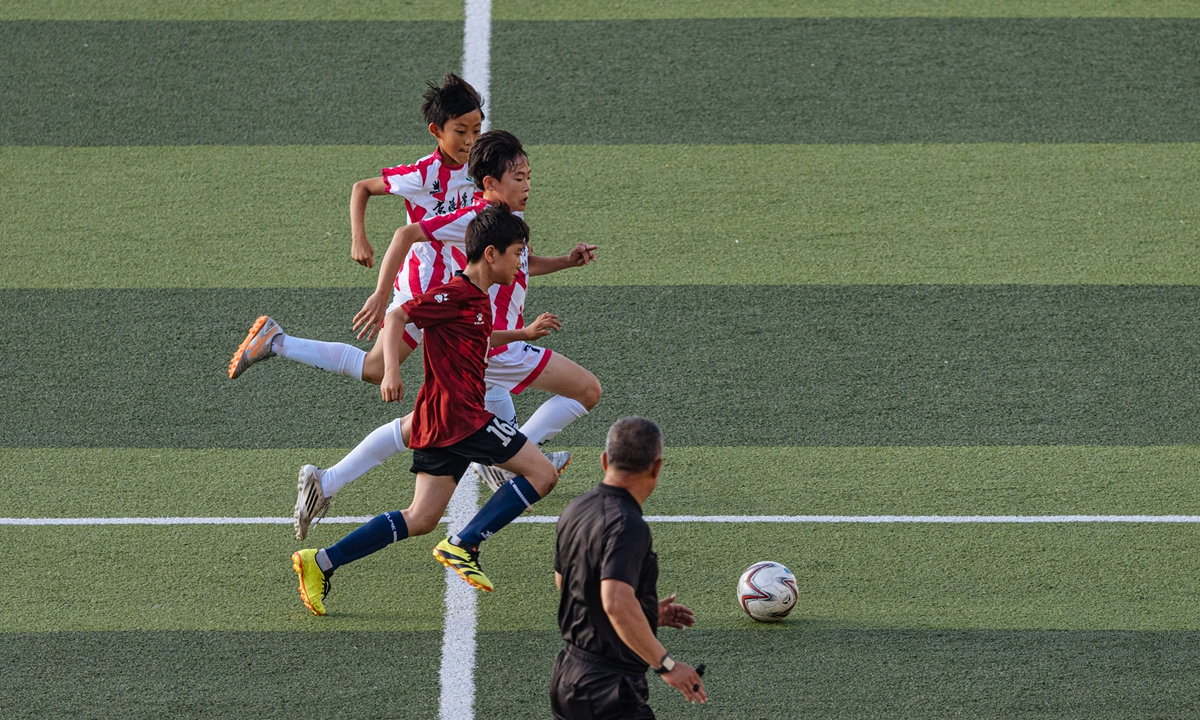
It was a busy school break. The national finals of the 2025-26 youth campus soccer league, rounds of the fifth China Youth Football League, city and provincial campus competitions, private club cups and overseas invitationals filled the calendar. Some children played close to home; others spent part of their summer travelling with teammates from one tournament to another.
The sixth 2034 Cup was among the most visible. Its 39 regional qualifiers drew 882 teams and 12,604 players, with 128 teams reaching the finals in Suzhou, East China's Jiangsu Province. Teams from other countries also took part, adding an international element to a tournament aimed at primary-school players, according to the Xinhua News Agency.
Does this crowded calendar by itself signal a turnaround for Chinese soccer? China's men last reached the World Cup in 2002. But the summer offered a view of a playing base being built from below and raised a harder question: Can the enthusiasm survive the return to school, unequal access to training and the growing costs borne by families?
From the first touch
In China's youth soccer system, coach Zhao Xinxin works at its broadest and most fundamental level - introducing young children to the game.
He coaches an introductory group of about 15 three-year-olds, three interest classes of 15 to 20 children aged five to 10, and four advanced groups of roughly 10 players aged five to 14. He has worked with more than 100 children over the years.
Starting younger is one of the clearest changes Zhao has observed in recent years. Soccer is appearing not only in schools and social clubs but also in some kindergartens. Most parents initially want an after-school activity that gets their kid moving.
Only when a player begins to stand out do questions about more advanced training and a possible route forward arise.
That route now has several layers. A child in a commercial club can move from introductory and interest classes to advanced teams. A school player may be selected for district and city teams, then enter national campus competitions; professional academies, sports schools and social clubs provide other pathways.
China began promoting campus soccer on a national scale in 2015, when six government departments issued guidelines calling for soccer to be incorporated into school education through designated soccer schools, regular competitions, teacher training and improved facilities, according to the Ministry of Education.
The program has continued to expand while shifting its focus from increasing participation to improving the quality of teaching, training and competition. In 2025, another 4,928 schools were recognized as national youth campus soccer schools, according to the ministry.
The result is more soccer on the calendar. Zhao told the Global Times that youth matches take place somewhere in Beijing almost every week, especially during school holidays. His club's advanced teams play weekend fixtures with referees and standings, as well as regional competitions and finals.
Tournaments such as the 2034 Cup give this broad base a visible target. Soccer commentator and youth-project organizer Dong Lu launched the event in 2021 after repeatedly seeing Chinese social media celebrate Japan's high-school soccer tournament. Its name looks toward the 2034 World Cup, when the first group of participants will be about 25.
Earlier this summer, a team selected through Dong's youth soccer project offered another source of encouragement. The Chinese Football Boy U12 team won all seven matches at the Sigismondi International Youth Cup in Italy, becoming the first Asian team to claim the championship.
Yet Dong cautioned against reading too much into a single championship. Strong players, he said, must emerge from a much broader soccer culture. "Players come from the people around us, from the soil and culture in which they grow," he told the Global Times.
Who can keep playing?
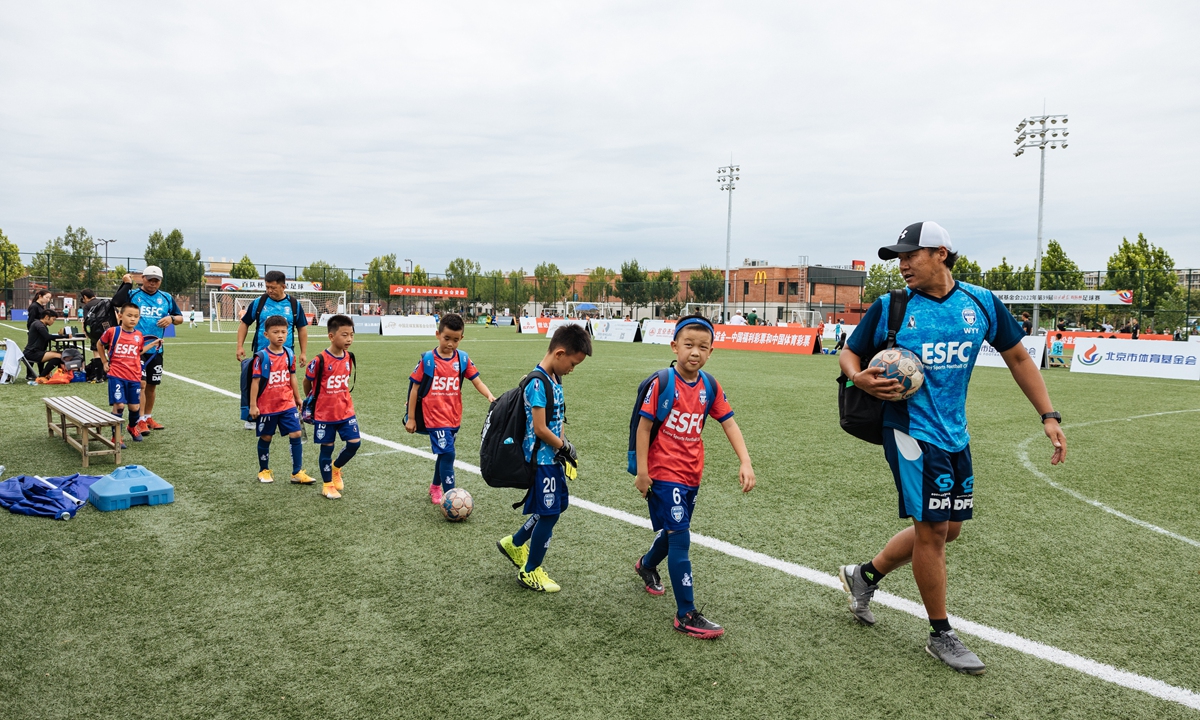
For Zhao, the first major break comes at 12. Children may train throughout primary school, then stop after entering middle school as homework, examinations and family expectations take over - a pattern he calls "retiring at 12."
Campus soccer should be the main way to keep the player pool broad, he said, because school is where nearly every child spends most of the day. More schools now provide soccer classes and in-class competitions, but implementation varies.
Zhao recalled a class tournament in which a child was injured. After a parent complained, the remaining matches were cancelled. Safety concerns are understandable, he said, but cancelling competition altogether removes opportunities from every child.
For families, this is also the stage when soccer stops being a simple extracurricular activity. If a child has shown unusual ability, parents must decide whether to seek stronger teams, change schools, accept more travel and training, or keep soccer only as an interest. The decision depends not only on talent and the child's wishes, but also on educational expectations and how much time and money the household can commit.
The contrast with Europe lies partly in continuity. Zhao cited his nephew in Hungary, who trained at a Barcelona-affiliated academy between the ages of six and eight before being selected by a local club at nine.
Once children join organized training there, he said, they are registered at relatively low cost, and their movement between clubs is recorded in the soccer association's system - closer to transferring schools than simply leaving one commercial course for another.
Dong made a broader comparison. Japan's national team increasingly draws on players who have further developed further in European leagues, while China still relies mainly on its domestic league to prepare future internationals.
In his view, the two systems operate like production lines with different competitive standards. Young Chinese players therefore need more high-level matches, whether foreign teams come to China, Chinese teams travel abroad or selected players enter overseas leagues.
But overseas training cannot substitute for a domestic system, nor is it open to every family. Zhao said it requires ability, physical readiness, money and the capacity to adapt to a different language, diet and daily life. Some parents send a child abroad; others move with them, reorganizing work and family life around soccer without knowing whether the child will ever turn professional.
For now, the most telling test may come not in 2034, but this coming September, when a child enters a new grade and decides whether there is still time in the week for soccer.
。 Disgraced singer-songwriter R. Kelly was sentenced to 30 years in federal prison on Wednesday, marking the end of a six-week trial in Brooklyn that included testimony from dozens of witnesses, including those who accused the 55-year-old of both sexual and physical abuse.,The US Attorney's Office for the Eastern District of New York was aiming for Kelly to be given at least 25 years behind bars, per a June 8 memo. The filing set forth that Kelly, now 55, should spend the rest of his life behind bars due to the fact he "avoided punishment for almost 30 years and must now be held to account.",Kelly's attorneys argued their client should only serve a decade behind bars because he "experienced a traumatic childhood involving severe, prolonged childhood sexual abuse, poverty, and violence.”,During sentencing Wednesday afternoon, US District Judge Ann M. Donnelly stated to the court that “the public has to be protected from behaviors like this.”,"These crimes were calculated and carefully planned and regularly executed for almost 25 years," Donnelly said, as reported by the New York Times.,The judge recounted a number of testimonies during sentencing, highlighting Kelly's pattern of sexual abuse and violence against women, girls, and boys.,Kelly's legal team plans to appeal the sentencing.,"We were prepared for it," said defense attorney Jennifer Bonjean, who represented disgraced comedian Bill Cosby in a civil case he lost earlier this month. "We are now prepared to fight this appeal.",© AP Photo / Elizabeth WilliamsIn this courtroom sketch, R. Kelly and his attorney Jennifer Bonjean, left, appear during his sentencing hearing in federal court, Wednesday, June 29, 2022, in New York. The former R&B superstar was convicted of racketeering and other crimes. In this courtroom sketch, R. Kelly and his attorney Jennifer Bonjean, left, appear during his sentencing hearing in federal court, Wednesday, June 29, 2022, in New York. The former R&B superstar was convicted of racketeering and other crimes. © AP Photo / Elizabeth Williams,Federal prosecutors say Kelly used his "deep network" and "larger-than-life musical persona" to gain access to teenagers and young adults--"many of whom were particularly vulnerable.","The government has little doubt that if afforded an opportunity to offend again, the defendant would do so," prosecutors said earlier this month. "He poses a serious danger to the public.",Lizzette Martinez, a woman featured in the documentary 'Surviving R. Kelly,' was accompanied by her attorney Gloria Allred when she took the stand to provide a witness statement.,"January 1995 eventually changed me forever," Martinez testified, detailing that she was a 17-year-old aspiring singer when she met Kelly in a mall.,Now 45, Martinez told the court that she was "left in shock, confused, and in tears" when Kelly, who promised to mentor her, began to abuse her.,“Robert, you destroyed so many people’s lives,” Martinez told Kelly, who did not make eye contact.,YouTube Deletes Two R. Kelly’s Channels Amid Sex-Trafficking Conviction6 October 2021, 09:18 GMT,“I do not know how to put a price on all I’ve gone through,” she said. “I am now 45, a mother and I struggle with mental health.”,Rumors and even footage of Kelly's misdeeds with minors and women have been circulating since the 90s, around the same time Kelly married teenage R&B artist Aaliyah. Despite dozens of alleged victims coming forward over the decades, accountability appeared to avoid Kelly until the 2019 documentary "Surviving R. Kelly" coincided with the #MeToo movement.,The intersection of the #MuteRKelly and #MeToo movements drummed up public support for victims seeking litigation against the Grammy-award-winning singer. Kelly is still facing a number of criminal charges in Chicago, Illinois, and Minnesota.,Kelly has remained behind bars since his initial arrest in July 2019. The singer-songwriter did not take the stand during trial.。
Current article:http://a04k3h.xiaqingzhuangdaminnan.cyou/7fui/esmhec.html
Published on:19:29:31


1
黄山旅游2026年上半年净利润1.3亿元,同比增长2.9%2
奇瑞在上海成立绿能慧碳科技公司3
三星S10支持超声波屏幕外指纹,但不能粘贴胶片4
【观点】南华期货:伦铜库存累积或弱化价格支撑,关注美元走强5
唐家三少当选北京作协副主席,日前宣布停更6
实跑784公里 达成率93.9% 小米YU7续航稳拿冠/季军7
China's private space sector launches AI-powered satellites as commercial push gathers pace8
曼晚:曼联持续关注布鲁日前锋特雷索尔迪,已知需要大约4300万镑9
记者:马尔穆什转会曼城的协议中,法兰克福未添加二转分成条款10
汇源通信:2026年半年度净利润约-858万元11
【乐学儿童】机幼宝贝上春晚啦!12
输意大利,中国女排无缘半决赛13
IIKBC表E412樱桃轴键盘新产品销售:619元,独立旋钮集成掌托14
抖音电商私自退款抽纸订单我要求赔偿15
费多拉想改变标志,而这两个设计团队不确定。
- 随机推荐
1
《Legend of the White Dragon》评测2
倒计时1天!湖北福彩3D游戏4000万元派奖活动即将开启3
科学家把废弃塑料瓶做成能吃的饼干,还有香草味4
多名中石油干部甘愿落入政治骗子陷阱 细节披露5
佛山彩民喜中双色球1034万大奖6
华为鸿蒙平板 HarmonyOS 7.0 花粉 Beta 版新增个人热点功能,支持自动识别网络并共享给其他设备7
1.16福宝精粹:元通快递10元优惠券,优酷31天免去广告权8
【透视社·反腐快报】贪了29年!中国人民银行原党委委员、副行长范一飞敛财超3.86亿9
比莉·派佩回应《Doctor Who》离奇悬念:称自己“不是下一任博士”,并呼吁粉丝们“冷静点”10
Farah Khan Praises Aryan Khan, Reveals Shah Rukh Khan Is Training Suhana Khan in Action for King11
贝壳找房旗下德佑门店房源层高虚假宣传,调解只给3000元体验金拒绝退还中介费12
家族办公室起到关键作用!东南亚投资者寻求更高回报率市场,新加坡成为最佳去处13
杭州PP市场多数价格走跌14
Jitendra Kumar & Mahvash to Star in Tedhi Hain Par Meri Hain15
DeepSeek又发新模型,小而美玩出新高度